

After Brady’s death, one of the first questions I had was: How long am I going to feel like this? A lot of people who lose loved ones wonder the same thing. Researchers have also asked this question. And many studies have looked for answers.
Typically researchers try to do this by having bereaved survivors fill out written assessments of their grief symptoms. (I wrote about some of the assessment tools used for measuring grief in this post, Yes, You Can Measure Grief and Here’s How. It might be worth a look. You could also assess your own grief symptoms.)
When the survivors’ scores are back to something like pre-loss levels, you could say that they have basically recovered from or integrated their grief.
As you would probably guess, soon after a loss people tend to score high on these assessments. As time goes by, their scores improve. When the survivors’ scores are back to something like pre-loss levels, you could say that they have basically recovered from or integrated their grief.
This is a judgment call, of course. But it does seem to be true that there are consistent findings that can help us come up with an answer to the question of how long grief lasts. Here are some of the results of the research into the duration of grief.
Relief May Start Pretty Quickly
One study from 2008 found grief symptoms of 288 bereaved people tended to peak at about four to six months after loss, then decline gradually over about a two-year period. Here’s a graph of those findings (note that the line that keeps rising measures acceptance, which isn’t a negative symptom):
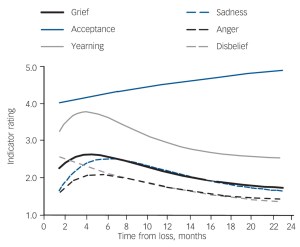
So perhaps you can expect to feel worse about a half a year after your loss, and better after that. Sometime in the second year, sadness, anger, disbelief and overall grief are likely to be back at manageable levels. The exception is the symptom of yearning for the lost loved one, which tends to remain relatively high even after the second year, according to this study.
Another study of 182 bereaved parents found, “Grief decreased from 3 to 13 months for mothers and from 3 to 6 months for fathers.” Note the difference in reactions between males and females. Other studies have also found gender differences in grieving. One of those is that women seem to tend to grieve longer and harder than men, and this is particularly true when it comes to bereaved mothers.
A lot of different things can influence your personal grief experience and make it harder and longer-lasting or shorter and easier. You can read more about the factors that can influence a person’s grief experience at this post: Risk Factors: Why Your Grief Is Unlike Anybody Else’s.
The Year of Grief May Be About Right
A very recent – 2017 – study took a good look at the grief duration question, analyzing six other studies that followed bereaved families of chronically ill patients. This is an example of a meta-study, which gathers together results of many studies. Meta-analysis like this can yield more reliable and useful results than a single study.
Sometime in the second year, sadness, anger, disbelief and overall grief are likely to be back at manageable levels.
This one found that after a year most of the bereaved families were back to the same levels of depression they exhibited before losing their ill relative. It’s interesting that a year is the traditional period of mourning in many cultures. These days, it’s popular to scoff at anyone who suggests a schedule for grieving, but based on this meta-analysis there may be something to the idea that a year is a good time to set aside for grieving.
About 10 percent of bereaved people experience only mild grief symptoms even immediately after the loss, and never suffer from more severe grieving.
It’s worth noting that about 10 percent of this study’s patients suffered from chronic depression after the loss. This is in keeping with many studies that report about that many people are likely to experience prolonged or complicated grief.
In a finding that surprised me the first time I saw it, other studies report that about 10 percent of bereaved people are likely to experience only mild grief symptoms even immediately after the loss and never suffer from more severe grieving. The middle 80 percent is generally likely to feel better after a year or so.
Sometimes Grief May Last Longer
Various factors other than gender can affect the duration of grief. For example, parents who have lost a child are often considered to be a special group. “You never get over the loss of a child,” is something I have been told many times. However, leaving aside for the moment the question of what exactly is meant by “get over”research suggests that it is, in fact, possible to substantially recover from the loss of a child in a lot less than forever. (I revisit this topic at more length in this post: What It Means to Get Over Loss.)
In one example of such a finding, this Swedish study from 2004 reports that seven to nine years after losing a child, parents were no more likely to suffer from psychological problems than non-bereaved parents. Bereaved parents were still more likely to experience higher levels of anxiety and depression at four to six years. That is a long time to suffer, for sure. But seven to nine years is still short of never.
Bereaved parents were more likely to experience higher levels of anxiety and depression at four to six years.
This 2004 Swedish study, incidentally, appeared to me to be an unusually good one as far as sample size and representativeness. The authors tried to contact every Swedish parent who’d lost a child to malignancy during a five-year period. They eventually got cooperation from 80 percent of the 561 parents asked to participate.
This is a larger sample than most grief studies use. It’s also more representative because they contacted every parent bereaved by malignancy and not just, say, those attending therapy or participating in support groups.
Also, at 80 percent the participation rate for this study is higher than usual. Many grief studies use so-called convenience samples of people who are easy for researchers to contact and recruit, but not very representative of the total population of grieving people. Ideally, a study will get participation from 100 percent of the target study group, but that rarely if ever happens.
Getting back to how long grieving is likely to last, an American study of violently bereaved parents found most could expect even shorter periods for recovery, although still longer than for most grievers. This one looked at 173 parents four, 12, 24, and 60 months after children’s deaths by accident, suicide, or homicide. It found 70 percent took “three or four years to put their children’s death into perspective and continue with their own lives.”
Seventy percent of bereaved parents took “three or four years to put their children’s death into perspective and continue with their own lives.”
Whether that amounts to getting over it is up to personal interpretation. And even if it is, the best case scenario of three years is a long time. But even two and a half more years of this (right now it’s been six months since Brady died) sounds a lot better than forever. (I look specifically at evidence about parental grief in this post “Do You Really Never Get Over Losing a Child?”)
Time Helps
If there’s one thing that everybody from researchers to bereaved grievers generally agrees on, it’s that time helps. The farther you get from the time of your loss, the better you are likely to feel.
There are exceptions to this tendency. Some people don’t seem to feel much better even after years or decades. However, the evidence strongly suggests that if there is a sure thing when it comes to grieving the loss of a loved one, time is that sure thing.
The evidence strongly suggests that if there is a sure thing when it comes to grieving the loss of a loved one, time is that sure thing.
How much time it’s going to take to feel better depends on various factors, including your gender and your relationship with the deceased. Some studies suggest that people who were more psychologically healthy before the loss get better sooner, and vice versa.
But for most losses you can expect to feel better after about a year. Those who have experienced particularly difficult losses, such as parents bereaved by suicide, may take a few years longer. For most of us, grief does have a sort of ending, or at least a time when it’s not nearly so intense.
For most of us, grief does have a sort of ending, or at least a time when it’s not nearly so intense.
I trust you’ve gained some useful and maybe even comforting insight into how long you’re likely to feel really horrible after your loss. As always, your mileage may vary. Different strokes for different folks. I’m not trying to tell you how you should grieve, or should not grieve, or guaranteeing that these studies will describe your individual experience.
These are just averages, and it is normal to not be exactly average. But knowing I am not likely to feel like this forever really helps me feel more optimistic. I hope it helps you as well and you get some peace today. Thanks for reading, liking, commenting, sharing and following Grieve Well.
 Grief Science
Thank you for the graph. I lost my young wife. She was 33 years old. I waited all my life for her and I am at 5 months and frankly feel as bad as I ever have. Now I can see with this graph that its nothing new.
LikeLiked by 1 person
Bradley, I am sorry for your loss, brother. I hope you get some relief soon. As the research suggests, that is distinctly possible, or even likely. Personally, I am still feeling pretty bad after seven months (today), but considerably better than I have been. Thanks for your comment and support. Mark
LikeLike
Thanks for sharing. I’m 11 1/2 months in from losing my wife. I’m 38 with 3 kids. Those graphs make sense, somewhere between months 6-8 I’ve started to feel better, and little by little, month by month the fog slowly recedes.
LikeLiked by 1 person
Thanks, Nathaniel. I’m sorry for your loss. It sounds like you have a difficult anniversary coming up. I hope it’s not too difficult. I’ve heard from a lot of others that the run-up to the first anniversary of a loss tends to be harder than the actual day. That was my experience this fall on the anniversary of Brady’s death. In any event, I’m glad the fog is slowly receding and hope it keeps up. This is a hard road we have to walk.
LikeLike
appreciating your writings. we lost 3 in a 6 mos period – both our dads and in between those losses – our granddaughter at 68 days old. a year later i lost my mom. so it’s complicated. the assessments assume only one loss – when i attempt to incorporate all the losses, my score skyrockets. it is a rare day when i don’t miss one of the four! i’m not even sure there has been such a day. The first death was 3.5 ys ago, my mom was 18mos. thank you for sharing out of your pain – it is helping me. and i hope that helps.
LikeLiked by 1 person
Thanks, sonshyne8. I am sorry for your losses. For sure, multiple losses is a factor in determining how we react. I hope you get some peace today. Thanks again.
LikeLike
Hi Bradley, My daughter sent me the link to this blog last night , we often do this ,since I lost my son ,aged 30,to acute pancreatitis, 5 months ago . I am his 62 yr old mother .
I read about your loss , I feel for you ,more than I would have before I suffered My own loss. Your way of dealing with the loss has motivated me to read and understand which side my own grief is headed.
Thanks for doing this .
LikeLiked by 1 person
Please forgive my mistake about your name ,Mark.
LikeLike
Thanks, Vipankaur. I am sorry for your loss. I can tell you that recently I have started feeling much better. I’m better able to accept that Brady is gone, that sometimes parents lose children in this world, and that somehow life is still worth living. It may not sound like much of a change. But I don’t feel nearly as often that I wish I were dead. And I go weeks without crying sometimes now. It’s a big improvement. I don’t know for sure what’s helped. It may just be the passage of time. It may just be a brief respite before the grief returns strongly. But it’s been a nice break, and I’m hoping for better days ahead. I hope you get some peace today. Thanks again.
LikeLiked by 1 person
Thanks for writing Mark and presenting this data.
I am a little behind the curves, but that’s OK. It’s been 9 months now and I definitely “yearn” for Andrew. The sadness is still there and I hope that starts to fall off in the next few months. The anniversary of Andrew’s death will be hard. I have good people around me to help. That’s important.
Again, thanks for presenting facts. It helps me deal with the loss.
LikeLike
Andrew, I think grief lasts longer for bereaved parents. Most grief research investigates experiences of white females who have lost husbands. Bereaved fathers are rarely examined. It appears to me that bereaved parents in general can likely expect to feel much better and perhaps something like normal after three to nine years. Bereaved fathers, however, tend to suffer less and for shorter periods than bereaved mothers. So that could be good news for you and me and others like us. All these are generalities. I’m not sure there is much evidence for what a typical bereaved father is likely to experience. One thing I’m pretty sure of is that patience is the most powerful and universally applicable tool that any bereaved person has. Usually, we get better with time. I hope you get some peace today.
LikeLiked by 1 person