

The urge to keep my son’s memory alive was one of the earliest and strongest impulses I experienced after he died. In lieu of flowers for his memorial service, we requested tax-deductible donations to a new Brady Henricks Scholarship Fund. Later I arranged to have a memorial bench installed next to a soccer field where he’d played and practiced countless times. Then we organized The Brady Henricks FootGolf Tournament (the sport is like golf played with a soccer ball and no clubs), a charity benefit to raise money for the scholarship, which helps disadvantaged kids pay to play high-level competitive soccer. On a personal note, I assembled a shadowbox displaying his high school letter jacket, soccer cleats, Xbox controller, Beats headphones and other personal memorabilia.
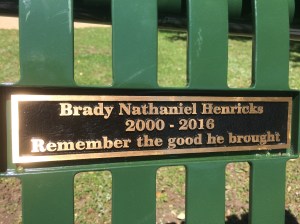 All this legacy-building made and continues to make me feel better. I remember being almost happy, or at least more fulfilled, as I wrote the check for the park bench. Many bereaved parents and other survivors are similarly concerned about memorializing and building the legacy of the lost loved one. And, while the subject doesn’t seem to have been studied a great deal, the research that has been done does suggest that legacy-building, memory-making and otherwise maintaining a continuing bond with a lost loved one can help survivors deal with grief.
The Evidence On Legacy-Building
A 2014 article in Death Studies — it and Omega are the two top grief research journals — examined families that have set up charitable foundations to memorialize deceased children. The researchers reported the activity “helped these parents make meaning of their children’s deaths and find purpose in the midst of their grief. Furthermore, philanthropy, as a way of making meaning and finding purpose, is a mutually beneficial process because it helps both the bereaved founders and the communities the organizations reach.” This sums up the reasons why we created Brady’s scholarship fund.
A 2016 Ph.D. dissertation discussed — at 220-page length — how terminally ill children’s memory-making and legacy-building activities before death helped survivors manage their grief. It described one of the basic grieving activities for children as “maintaining a continuing, appropriate attachment to the person who died through such activities as reminiscing, remembering, and memorialization…” This can also be applied to adults, and it’s what I wanted to do with the fund, tournament, bench and shadowbox.
All this is part of maintaining a connection to the lost loved one. The idea that this is a good thing is the opposite of what Sigmund Freud recommended in his 1917 essay, “Mourning and Melancholia.” Freud said a major task in grieving is to sever ties to the deceased. This attitude ruled grief therapy until fairly recently. For most of the intervening century, grief counselors nearly universally urged survivors to let go of the deceased so they could move on.
In the last couple of decades, there’s been an about-face and now maintaining connection is widely seen as helpful. This stems from evidence for the value of finding meaning in a loss (I discussed this in a post on Making Sense of Senseless Tragedy). As an example of the specific research on connections, one 2010 Death Studies study looked at 276 bereaved parents and found most were able to find meaning in their loss. Researchers went on to say, “Meaning came from connections with people, activities, beliefs and values, personal growth, and connections with the lost child.”
Some Memorial Limitations
There are some catches to memorials. For one thing, when a student dies of suicide, many schools are reluctant to permit permanent on-campus physical memorials. This policy is recommended by a number of organizations including in America the National Association of School Psychologists. The thinking is that on-campus physical memorials and tributes are likely to encourage other students to take their own lives. I have not seen evidence that this is actually so, but it does conform to common sense and, perhaps, preexisting prejudices against suicide. There are exceptions. I know of one school baseball stadium that was named after a friend’s baseball star son after the young man died of suicide. However, as a general rule, this is going to be a tough sell.
Another complicating factor is that not all memorializing and maintaining of continuous bonds is associated with getting better faster. For instance, a 1999 study of bereaved spouses found that “use of the deceased’s possessions to gain comfort” was associated with more and longer-lived grieving distress. This doesn’t mean that keeping mementos of a lost loved one will make you suffer more. It’s a matter of degree. George Bonanno, a prominent grief researcher, in his 2010 book “The Other Side of Sadness,” explains that obsessively maintaining a deceased person’s room exactly as it was, for instance, is probably an example of an unhelpful way to remember someone. I don’t think my shadowbox is an example of that kind of extreme effort. I guess we’ll see.
Also, not every survivor is in a financial or other circumstance that will allow them to do it the way we did it. A lot of stuff fell together to help us build Brady’s legacy. The soccer league he played in is handling many details, including handing out scholarships and delivering charitable tax-deduction paperwork to donors. His mother’s business connections have helped land sponsors of the tournament. I was lucky enough to have a little extra money to pay for the bench.
My previous personal experience setting up a scholarship for a college classmate who became profoundly disabled is what suggested the Brady scholarship to me in the first place. That fund still hands out journalism scholarships in my friend’s name after 20 years and, as a permanent endowed scholarship at the University of Texas at Austin, will presumably do so forever. I thought that was pretty great, and wanted to do something like it for Brady.
Brady loved soccer with a burning passion and was a star player, scoring two hat tricks and averaging a goal a game during his last full season. He was also an exceptionally kind kid, always first to help up a player who’d been knocked down or loan money to a friend. In 500 or more refereed matches, he received only one red card penalty, despite being involved in more violent collisions than I could count. His playing style and ability prompted more than one less even-tempered opponent to lash out with a fist or elbow, earning that player a red card and immediate ejection. This generally amounted to winning the game for his team, since in soccer a team must continue one player short if a team member is ejected. I am very proud of my son, in case this is not clear.
A Menu of Memories
Now Brady is pretty well memorialized, I’d say. The footgolf tournament looks like it will become an annual event. (2018 update: The second annual Brady Henricks FootGolf Tournament was held June 2. It was a success and we are planning the 2019 event.) The scholarship, hopefully, will be a permanent benefit to disadvantaged soccer players. The bench will apparently offer a shady resting spot long after I am gone. The shadowbox reminds me of him every time I see it.
There are many ways to memorialize and build a lost loved one’s legacy. Funding scholarships, organizing tournaments and walks and runs, planting trees and creating in-home memorials are just a few. There also online digital memorials such as Facebook memorial pages, of course. These will likely be the subject of a future Grieve Well post.
I hope this post has caused you to think about why and how you might want to remember your lost loved one. And I hope you’ll take it in the spirit in which it is given — as a personally flavored account of the evidence for legacy-building and memory-making as tools to help survivors make the grief journey faster and with less suffering. I’m not telling anybody how to grieve, just how they might grieve if this approach appeals.
I also hope you’ll comment, like and share posts you enjoy, and consider signing up for email notifications of new posts. Finally, I hope every reader who is struggling with the loss of a loved one gets some peace today.
 Grief Science
What wonderful ways to honor Brady’s life, Mark, and yes, your pride in him is clear! Thank you for writing yet another piece that is well worth sharing, which I am happy to do (via my Twitter feed and Tools for Healing board on Pinterest). I’ve also added a link to your piece at the base of my own posts, In Grief: Remembering Is An Active Process, http://bit.ly/2omxkBr and The Power of Remembering: My Grandfather’s Pipe, http://j.mp/KPIfZF ♥
LikeLiked by 1 person
Thanks, Marty. Your feedback is much appreciated and I am very grateful for all you do to help people struggling with grief.
LikeLiked by 1 person