

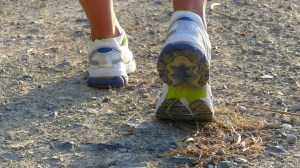
In the days immediately after Brady died I was doing well to walk in a straight line. When I ventured out to stroll around the block someone had to hold my elbow while I shuffled along like a centenarian. This was a switch for a lifelong exerciser who that year had completed a number of running, swimming and bicycling events.
As the fog thinned in the next few weeks, I decided to get back to exercising. One reason was that it was something I’d always done. Another reason was that I had the impression exercise was an effective treatment for mental and emotional ills.
Running Down Grief
So a few weeks after my son’s death, I set off to jog three miles through the neighborhood. It was excruciating. I gasped. I sobbed. Tears streamed down my cheeks. I kept going because that was what I always did. I’m not fast but I don’t quit.
After a few blocks, it occurred to me that perhaps I was running from grief. Running from my problems didn’t sound smart. So I decided I wasn’t running from grief. I was running after grief. Grief was running from me.
I decided I wasn’t running from grief. I was running after grief. Grief was running from me.
I imagined grief as a demon on the road ahead. In my imagination, I caught up and stepped on its tail. It fell. I kicked the demon, again and again. I jumped up and down on it until it was crushed and still.
That was somewhat gratifying but also seemed harsh and negative. So I imagined I was chasing life. I caught up to life and ran alongside. Life was a fit young man who put his arm around my shoulder and helped me along. After a while life picked me up and carried me. I still cried, sometimes in despair, sometimes with hope that maybe I’d rejoin the living someday. It was a challenging run, and a slow one, but I didn’t quit.
I gradually resumed regular swimming, biking, running and gym workouts. I entered races, completing a couple of runs, an open-water swim and a sprint triathlon. Six months after Brady died I ran the Capitol 10K in what was for me a respectable time. I wore one of his soccer jerseys, which is something I’ve started doing on runs.
Has Exercise Helped Me?
I don’t know if regular exercise has made it any easier to cope. I can’t say for sure that any of the strategies I’ve tried have helped. I might feel the same today if I’d done nothing but stay in bed and cry.
One reason I can’t say for sure that evidence-based coping strategies have worked for me is that there’s no control group for comparison. This is a life, not an experiment.
I can say that I am friends with two parents who lost teenagers in the last year, including a mother I met in an online grief group whose 17-year-old son died the same day and the same way as Brady. We talked often in the months after our losses and I still get in touch with them occasionally. They’ve taken their own paths to dealing with loss and, to be honest, they seem to be doing about as well or as badly as I am.
Even if I can’t be sure whether my personal experience means anything, there is still a lot of evidence suggesting that physical exercise can improve mental and emotional health, including the ability to be resilient under stress and recover from trauma.
Evidence for Exercise
Many studies going back many years have examined the effect of exercise on various aspects of mental and emotional health, but only a few look specifically at exercise and bereavement.
I found one 2015 study that reported positive effects of qi gong, a traditional Chinese healing practice involving light exercises, on bereaved people who also suffered from chronic fatigue syndrome. A 2012 doctoral thesis looked at exercise as a way of helping bereaved people gain insight into a loss. A 1987 study found aerobic exercise benefited subjects coping with stressful life experiences. That was about it, as far as I can tell.
Exercise research may not have much to say about grief, but much evidence suggests that exercise helps depression and overall mental health. Rather than listing a bunch of papers, I’ll offer one 2014 study that analyzed four meta-analyses, each analyzing a number of other studies that all looked at the connection between physical exercise and mental health. The title of this study of studies of studies says it all: “Exercise therapy improves both mental and physical health in patients with major depression.”
The title of this study of studies of studies says it all: “Exercise therapy improves both mental and physical health in patients with major depression.”
Of course, there is more to grief than depression. There’s guilt, yearning and anxiety, to name a few. But some studies of anxiety also suggest exercise can help. And the evidence for exercise benefiting overall mental health is stout. It seems reasonable to conclude that exercise likely helps with rotten feelings after bereavement.
How Much Does It Take?
Next question: What kind of exercise? How much? For how long? Several studies looked at these questions. One of the better-looking ones is a 2013 study, Exercise and the treatment of depression: A review of the exercise program variables.
This study by Australian researchers analyzed five randomized control trials (RCTs, as they call them, are pretty much the gold standard for this kind of research.) It concluded that three sessions a week of medium-intensity aerobic exercise for at least nine weeks is likely to help with depression. The typical length of the sessions was 30 to 45 minutes. Say, a brisk walk of a mile or two every other day.
Three sessions a week of medium-intensity aerobic exercise for at least nine weeks is likely to help.
Studies tend to evaluate exercise not in isolation but as an add-on to medication or talk therapy treatments. Certainly my approach is to try a bunch of different strategies, in the hope that enough of them will have enough positive difference that I’ll feel significantly better sooner than if I did something else.
Your mileage may vary. Walking the dog a few times a week is not guaranteed to instantly make you feel exactly like your old pre-loss self. It’s just likely to help some. That’s true of all these evidence-based strategies.
Walking the dog a few times a week is not guaranteed to instantly make you feel exactly like your old pre-loss self. It’s just likely to help some.
I’ve kept up the exercise and signing up for events. A couple of months after the 10K, I finished a sprint triathlon. I went on a week-long wilderness backpacking trip, in addition to a couple of weekend hikes. Recently I’ve taken up river kayaking and am training for another sprint triathlon next month.
Training keeps me busy and distracts me while time does whatever healing it can. It’s not terribly expensive or, barring the occasional injury, dangerous. I’ve met people, made new friends, had fun, seen sights, felt pride in accomplishment and gotten some new t-shirts. It doesn’t seem to hurt and may help. I’m going to keep doing it.
I hope this post has given you some insight into the evidence on exercise as a bereavement grief coping strategy. Please don’t take it as criticism of anyone who doesn’t care to exercise. Different strokes for different folks. This is my report on my experience, not a prescription for everybody or anybody.
Thanks for reading, commenting, liking, sharing, re-blogging and subscribing. Follow Grief Science by clicking the button to the right and entering your email address. You will get a notice when I post something, which is once a week or so. I won’t share your info with anybody.
I am sorry for the loss that brought you here, and hope you get some peace today.
 Grief Science
Anything which helps is good. l think one thing you havent mentioned is with some exercise you can be one with nature and the beauty for you eyes and smell lift your mood 💖 a grieving mum 😔
LikeLiked by 2 people
Agreed. Every second we can steal from this pit of blackness is it a triumph for life, the way I see it. I’m sorry for your loss, Maureen, and I hope you get some peace today.
LikeLike
That’s a good point about nature. I wrote about the evidence for nature helping with grief not long ago: https://grievewellblog.wordpress.com/2017/05/08/can-being-in-nature-help-your-grief/
LikeLiked by 1 person
Thanks!
LikeLike